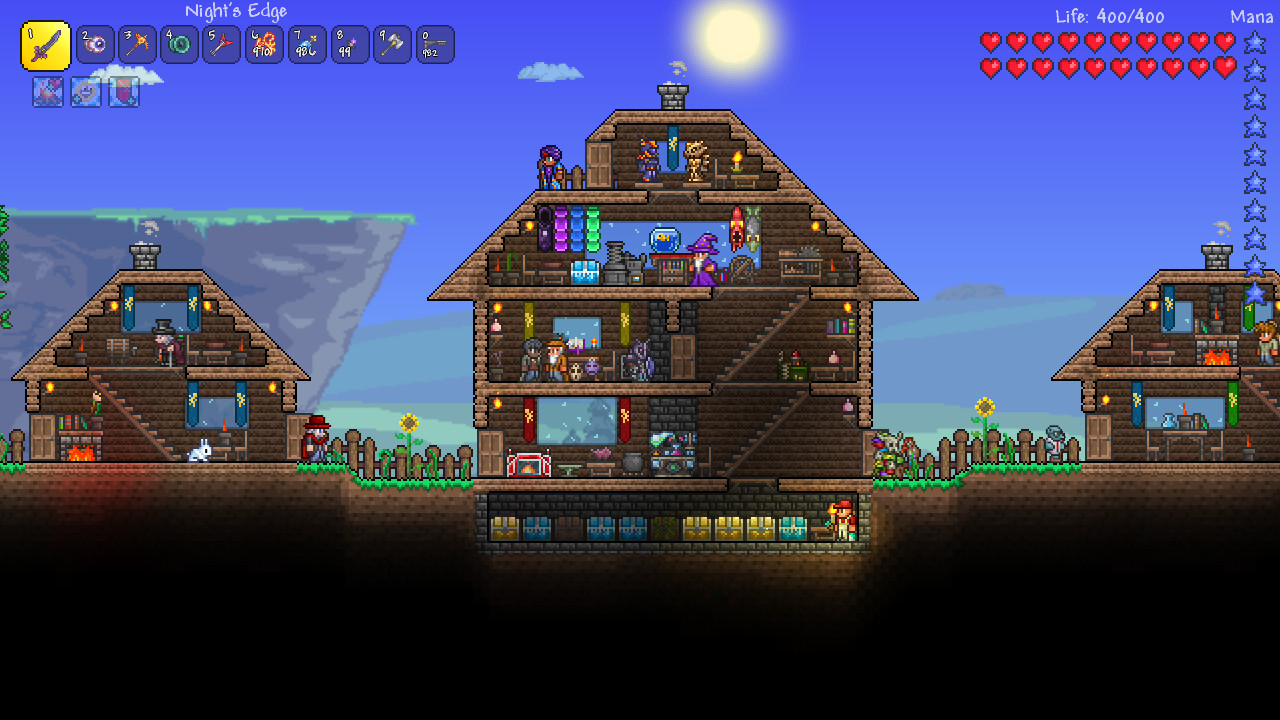
Nothing slows down a new Terraria world like the dreaded “This housing is not valid” message. NPCs only move in once you build a room that ticks every box the game checks, and the rules are stricter than they look. This guide breaks down exactly what makes a house valid, the most common reasons a room gets rejected, and how to build efficient multi-room towns that house your whole NPC roster. Every number here is taken straight from the official Terraria Wiki.
The four furniture requirements every house needs
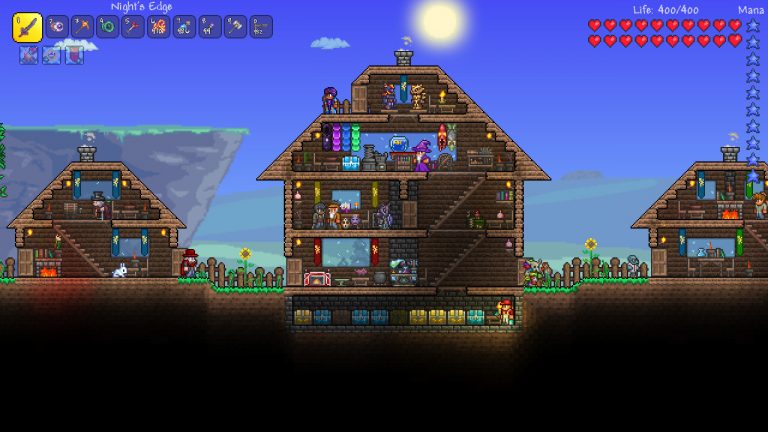
A valid house must contain one item from each of four categories. The game groups them internally as a light source, a “table,” a “chair,” and a door/entrance. You can mix and match freely within each group, but you must have at least one of each.
| Requirement | Qualifying items (examples) |
|---|---|
| Light source | Torches, candles, lanterns, chandeliers, fireplaces, lamps |
| Flat surface (“table”) | Tables, work benches, dressers, bookcases, pianos, bathtubs, Alchemy Table, Bewitching Table |
| Comfort item (“chair”) | Chairs, beds, sofas, benches, thrones, toilets |
| Door / entrance | Wooden door, Tall Gate, Trap Door, or a platform in the wall, floor or ceiling |
A bed is worth highlighting because it pulls double duty: it counts as a comfort item for housing, and it can also be used to set your spawn point (though using a bed as a spawn has its own slightly different requirements). One bed in a room therefore covers the comfort slot while doubling as a respawn anchor.
Size: not too small, not too big
Terraria measures the enclosed interior of your room and rejects anything outside a fixed range. A house must contain at least 60 total tiles and fewer than 750 total tiles, counting the frame. The minimum workable rectangle the wiki cites is 3 tiles wide by 10 tiles high (interior), which becomes 5 by 12 once you include the surrounding frame.
In practice, most players build comfortable rooms around 5 to 7 tiles tall and 8 to 12 tiles wide, which sits safely inside the range. If a single room ever feels too cavernous and gets rejected for being too large, just split it into two with a dividing wall, and you get two valid houses out of the space.
Walls, frame and enclosure rules
This is where most invalid houses go wrong. The room needs a complete frame and a solid background.
- Background walls must be player-placed. Naturally occurring walls such as Dirt Walls do not count as valid background. The wiki is explicit: “Unsafe walls (such as naturally-occurring Dirt Walls) do not count as valid background walls.” If you dig a room into a hillside, you must hammer out the natural wall and place your own wall (wood, stone, etc.) behind the whole interior.
- The frame must be completely sealed. The internal area has to be entirely unconnected to the outside. Solid blocks, platforms, Trap Doors, doors and Tall Gates all count as frame.
- No large gaps. Holes that are 5 tiles or more in width or height are not permitted in the frame.
- The floor cannot be all platforms. You can use platforms for floors, ceilings and walls, but the NPC needs at least one solid (non-platform, unactuated) block to stand on, with the tiles directly to its left and right also solid.
One reassuring detail: liquids inside a house do not invalidate it. The wiki states plainly that “liquids will not affect the validity of a house,” so a stray pool of water (or a deliberate lava trap below the floor) won’t break the room, even if it’s a questionable interior-design choice.
Corruption, Crimson and the “evil score”
Even a perfectly built room becomes uninhabitable if it’s surrounded by evil biome tiles. The game assigns an “evil score” to nearby blocks. Corruption, Crimson and their equivalents each add points, while Hallow tiles subtract a point and each Sunflower subtracts a sizeable chunk.
If the evil score reaches at least 50, the house is invalid and you’ll see “This housing is corrupted.” At a score of 300 or more, the message changes to “This is not valid housing.” The fix is to clear nearby evil blocks, plant Sunflowers (which actively lower the score), or simply build your town a healthy distance away from the Corruption/Crimson before Hardmode spreads it further.
Why is my house invalid? Quick checklist
- Missing one of the four furniture items (light, flat surface, comfort, door).
- The background still shows natural Dirt/Stone wall instead of a placed wall.
- There’s a gap of 5 or more tiles in the frame, or the room isn’t fully sealed.
- The room is under 60 tiles or 750+ tiles in total.
- No solid block exists for the NPC to stand on (entire floor is platforms).
- Too much nearby Corruption/Crimson pushing the evil score over the limit.
Multi-room and apartment designs
Once you understand the frame rule, stacking houses is easy and space-efficient. Build a tall structure and divide it into floors using solid blocks (with a Trap Door or platform between levels for access). Crucially, each room must be its own sealed cell: a shared wall between two rooms counts as both rooms’ frame, so an apartment block is just a grid of valid rooms sharing partitions. Each cell still needs its own light, table, comfort item and door.
A clean approach is a 3-to-4 story tower with two rooms per floor, platforms for the floors between levels, and a door on the ground level. This packs many NPCs into a small footprint, which matters because tightly clustered towns are exactly what the happiness system penalizes if you overcrowd them.
Don’t stop at “valid” – aim for happy
A valid house gets an NPC to move in, but where you put it determines how much they like you. NPCs get roughly a 12% or 6% modifier for living in a loved or liked biome, and they react to their neighbors and to crowding: they’re happiest with no more than two other NPCs within 25 tiles and no more than three within 120 tiles. Happy NPCs drop their prices (down to about 75%) and, critically, will sell you a Pylon for their biome once their price modifier sits at or below 90%, letting you build a fast-travel network. So once your houses pass the validity check, the next step is arranging them by biome and good neighbor pairings rather than cramming everyone into one block.
Frequently asked questions
Does a house need a door if I use platforms?
You still need one valid entrance, but a platform counts as one. A platform placed in a wall, the floor or the ceiling satisfies the door requirement, so a platform-access apartment is valid as long as the NPC also has a solid block to stand on.
Can I dig a house into the ground?
Yes, but you must remove the naturally occurring background wall and replace it with a wall you place yourself. Natural Dirt or Stone walls are “unsafe” and do not count, which is the single most common reason an underground room reads as invalid.
Why did a house that worked before suddenly become invalid?
The usual culprit is spreading Corruption or Crimson after entering Hardmode, which raises the nearby evil score past the threshold. Clearing the evil blocks or planting Sunflowers (each one lowers the score) typically restores validity. Note that desktop version 1.4.5 made several housing checks more lenient, including allowing platform home tiles, so behavior can differ slightly between game versions.
If you want to build a sprawling town together, setting up an always-on Terraria world you and your friends can drop into anytime means your NPC apartments and pylon network stay up even when you log off. Our Terraria server setup documentation walks through getting it running. For more world-building know-how, see our Terraria Biomes Guide to place NPC towns in the right biomes, and the Terraria Potions and Buffs Guide to power up before you push into Hardmode.
Ready to play?
Run your own Terraria server with XGamingServer
Spin up an always-on Terraria server your friends can join in minutes — no port-forwarding, no tech headaches.