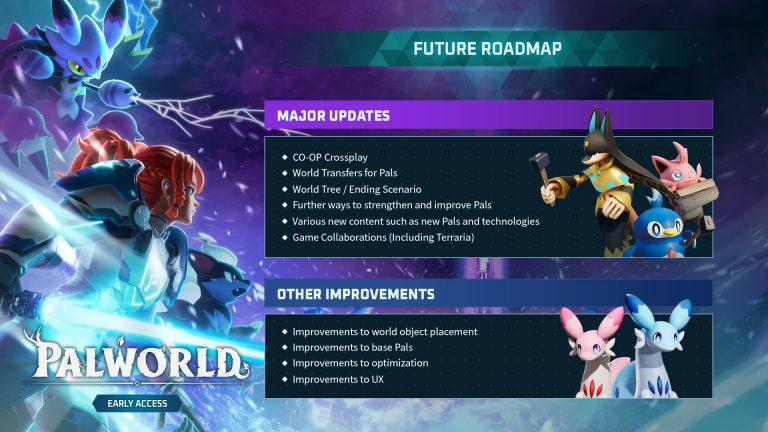
Palworld gives you two very different ways to play with friends: quick invite-based co-op, or a proper dedicated server. They sound similar but behave nothing alike — one is capped at four players and dies when you log off, the other holds 32 players and runs 24/7. Here’s exactly how they differ and which to pick.
Co-op vs dedicated server at a glance
| Invite co-op | Dedicated server | |
|---|---|---|
| Max players | 4 | 32 |
| Always online? | No — world only exists while the host is in-game | Yes — runs 24/7, join anytime |
| Who hosts it | One player’s PC/console + their internet | A dedicated machine, independent of any player |
| Performance | Limited by the host’s hardware & upload | Dedicated CPU/RAM, no host bottleneck |
| Admin tools | Minimal | Full admin/RCON commands, config, bans |
| Backups | Manual / host’s local save | Automated, scheduled, restorable |
| Crossplay | Supported | Supported (all platforms on one world) |
| Cost | Free | Monthly hosting fee |
Invite co-op: simple, but tied to the host
Co-op is the zero-setup option. You open your world, invite up to three friends (four players total), and play. The catch is fundamental: the world only exists while you, the host, are online. When you log off, nobody can play, and progress is tied to your save on your machine. Performance also depends entirely on the host’s PC and home internet — if their connection hiccups, everyone feels it.
Co-op is perfect for a couple of friends playing the same hours. It falls apart the moment people are in different time zones or want to log in while you’re asleep.
Dedicated server: 32 players, always online
A dedicated server removes the host bottleneck entirely. The world lives on a separate machine that’s online 24/7, so anyone can join whenever they like — whether you’re playing or not. You get up to 32 player slots, full admin and config control, automated backups, and the headroom to run mods and big automated bases without tanking one person’s PC.
This is the right choice for any real community, a server that needs to persist, or a group spread across time zones. The trade-off is a monthly fee and a (small) amount of setup — though managed hosts reduce that to a one-click install. Worth knowing: Palworld’s full 1.0 release on July 10, 2026 adds Server Clustering, which links dedicated-server instances for even higher player counts.
Which should you choose?
- Choose co-op if it’s just you and 1–3 friends who play together at the same time and don’t mind the world being offline otherwise.
- Choose a dedicated server if you want more than 4 players, an always-online world, admin control, backups, or anyone joining on their own schedule.
If a dedicated server is the way to go, you can rent a managed Palworld server on AMD Ryzen 9 7950X hardware with one-click setup, automated backups and 24/7 uptime — no need to leave your own PC running. Before you buy, it’s worth checking how much RAM a Palworld server needs for your group size.
Frequently asked questions
How many players can play Palworld together?
Up to 4 in invite co-op, or up to 32 on a dedicated server.
Does the Palworld world stay online without the host?
Only on a dedicated server. In co-op, the world is gone the moment the host logs off.
Can different platforms play on the same Palworld server?
Yes — Steam, Xbox, PS5 and Mac players can share one world. See how Palworld crossplay works.
Free Palworld Tools
Speed up your server with our free Palworld tools:
- Interactive Map
- Breeding Calculator
- Breeding Combos
- Catch Rate Calculator
- Pal Finder
- Pal Tier List
- Stats Calculator
- Passive Skills
- Work Suitability
- Recipes
- Weapons List
- Type Checker
- server.cfg Generator
- Admin Commands
- Pal Randomizer
- Save Editor
- SteamID Converter
- Server REST API
- Paldex (289 Pals)
- Item Database
- Loot & Drop Finder
- Spawn & Level Finder
- Learnsets
- Moves Database
- Tech Tree Planner
- XP Calculator
- Boss Locator
- Base Building Planner
- Lab Research
Ready to play?
Run your own Palworld server with XGamingServer
Spin up an always-on Palworld server your friends can join in minutes — no port-forwarding, no tech headaches.