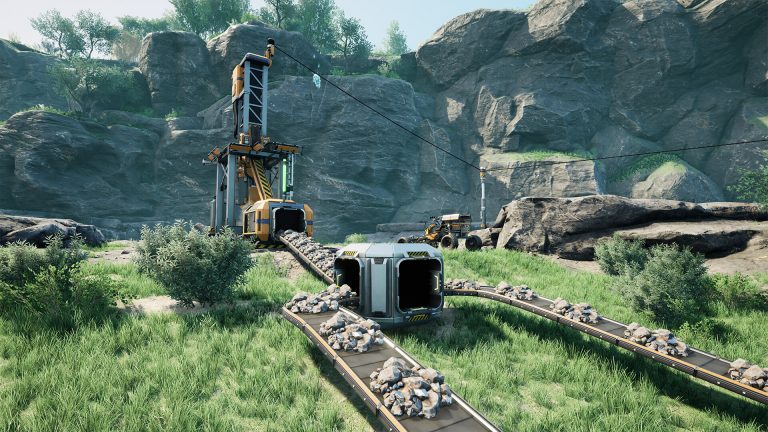

Aluminum is the Tier 7 wall that stops more Satisfactory factories than any other resource. It is the game’s first true closed-loop fluid product: refining bauxite produces a liquid intermediate, and turning that liquid into solid scrap hands you water back. If you do not plumb that returned water correctly, your pipes fill up, output stalls, and the whole line deadlocks. This guide breaks down the full aluminum chain with verified recipes and rates, shows the throughput ratios that keep it running, and explains the water recycling loop that trips up so many engineers.
How aluminum is made in Satisfactory
The standard chain has three stages, all unlocked under Tier 7 – Bauxite Refinement:
- Alumina Solution — a Refinery turns Bauxite + Water into liquid Alumina Solution (plus Silica as a byproduct).
- Aluminum Scrap — a Refinery turns Alumina Solution + Coal into solid Aluminum Scrap, returning Water as a byproduct.
- Aluminum Ingot — a Foundry smelts Aluminum Scrap + Silica into Aluminum Ingots.
From there, ingots become Alclad Aluminum Sheet (Assembler: 3 Aluminum Ingot + 1 Copper Ingot) and Aluminum Casing (Constructor: 3 Aluminum Ingot), which feed cooling systems, heat sinks, and most late-game machinery.
The verified recipes and rates
All numbers below are the in-game per-minute rates at 100% clock speed. Per-minute fluid rates assume the machine is fully fed; the actual numbers depend on the recipe you choose.
| Recipe (building) | Inputs / min | Outputs / min |
|---|---|---|
| Alumina Solution (Refinery) | 120 Bauxite + 180 Water | 120 Alumina Solution + 50 Silica |
| Sloppy Alumina (alt) (Refinery) | 200 Bauxite + 200 Water | 240 Alumina Solution (no Silica) |
| Aluminum Scrap (Refinery) | 240 Alumina Solution + 120 Coal | 360 Aluminum Scrap + 120 Water |
| Aluminum Ingot (Foundry) | 90 Aluminum Scrap + 75 Silica | 60 Aluminum Ingot |
| Pure Aluminum Ingot (alt) (Smelter) | 60 Aluminum Scrap | 30 Aluminum Ingot |
The water recycling loop (why factories jam)
Here is the core problem. The standard Alumina Solution recipe consumes 180 Water per minute, but the standard Aluminum Scrap recipe hands you 120 Water per minute back. That returned water is real and must go somewhere. If you simply pump fresh water in at full rate while recycled water also enters the line, the pipe pressure rises, machines can no longer drain into a full pipe, and production halts.
The fix is to feed the recycled water back into the Alumina Solution refineries first, and only top up with fresh water for the shortfall. The practical rules:
- Merge recycled water before fresh water. Route the scrap-refinery water into the alumina water line, then add an extractor line behind it.
- Use a Valve on the fresh-water input to cap how much new water enters, so the recycled water is always consumed first.
- Mind pipe headlift and elevation. A full pipe with nowhere to drain is the failure mode — keep byproduct water flowing downhill or level into consumption, never into a dead end.
- Prime the pipes after building, and let the loop stabilize before scaling up.
Because aluminum is a fluid-heavy, always-running loop, it is sensitive to tick instability on a struggling host. If your scrap refineries randomly stutter in multiplayer, that is usually performance, not your math — our guide to fixing Satisfactory multiplayer lag covers the server-side causes. A properly resourced dedicated box for your Satisfactory world keeps fluid simulation consistent so your loop behaves the same whether you are online or not.
Throughput ratios that balance cleanly
Using only standard recipes, the chain balances like this:
- 2 Alumina refineries → 1 Scrap refinery. Two alumina refineries produce 240 Alumina Solution/min, exactly feeding one scrap refinery (which needs 240/min and outputs 360 Scrap/min).
- Water: those two alumina refineries draw 360 Water/min; the scrap refinery returns 120/min, so net fresh water is 240/min.
- 360 Aluminum Scrap/min feeds 4 Foundries at the standard ingot recipe (90 Scrap/min each), needing 300 Silica/min and producing 240 Aluminum Ingot/min.
Note the Silica balance: standard alumina gives 50 Silica/min per refinery (100 from two), but standard ingots want 300 Silica/min — so you will need extra Silica from Raw Quartz unless you use a recipe that changes the ratio. This is exactly why alternate recipes matter at this tier. Sloppy Alumina doubles alumina output per refinery but produces no Silica, while the Pure Aluminum Ingot alternate drops Silica from the ingot step entirely. Which combination is “best” depends on your nodes and goals — see our alternate recipe tier list before committing concrete. If you want exact machine counts and power draw for your target rate, plug the numbers into a recipe and power calculator.
For setting up the dedicated server that hosts your aluminum megabase, our Satisfactory server documentation walks through installation, ports, and admin configuration.
FAQ
Why does my aluminum factory keep stopping?
Almost always the water recycling loop. The Aluminum Scrap recipe returns 120 Water/min, and if that water has nowhere to drain, the pipe fills and the refinery cannot output, which halts the whole chain. Feed recycled water back into your Alumina Solution refineries first and use a valve to limit fresh water to the shortfall.
Is Sloppy Alumina worth using?
Sloppy Alumina is an alternate recipe (from Hard Drive scanning after Tier 7) that produces 240 Alumina Solution/min from 200 Bauxite + 200 Water, with no Silica byproduct. It is far more bauxite- and machine-efficient per unit of alumina, but you lose the free Silica, so you must source Silica separately for ingots. Whether it wins depends on your bauxite supply.
What ratio of refineries do I need for aluminum ingots?
With standard recipes: 2 Alumina refineries feed 1 Scrap refinery (240 Alumina Solution/min), which produces 360 Aluminum Scrap/min, enough for 4 Foundries making 240 Aluminum Ingot/min. You will still need extra Silica beyond what alumina refining provides.
Ready to play?
Run your own Satisfactory server with XGamingServer
Spin up an always-on Satisfactory server your friends can join in minutes — no port-forwarding, no tech headaches.