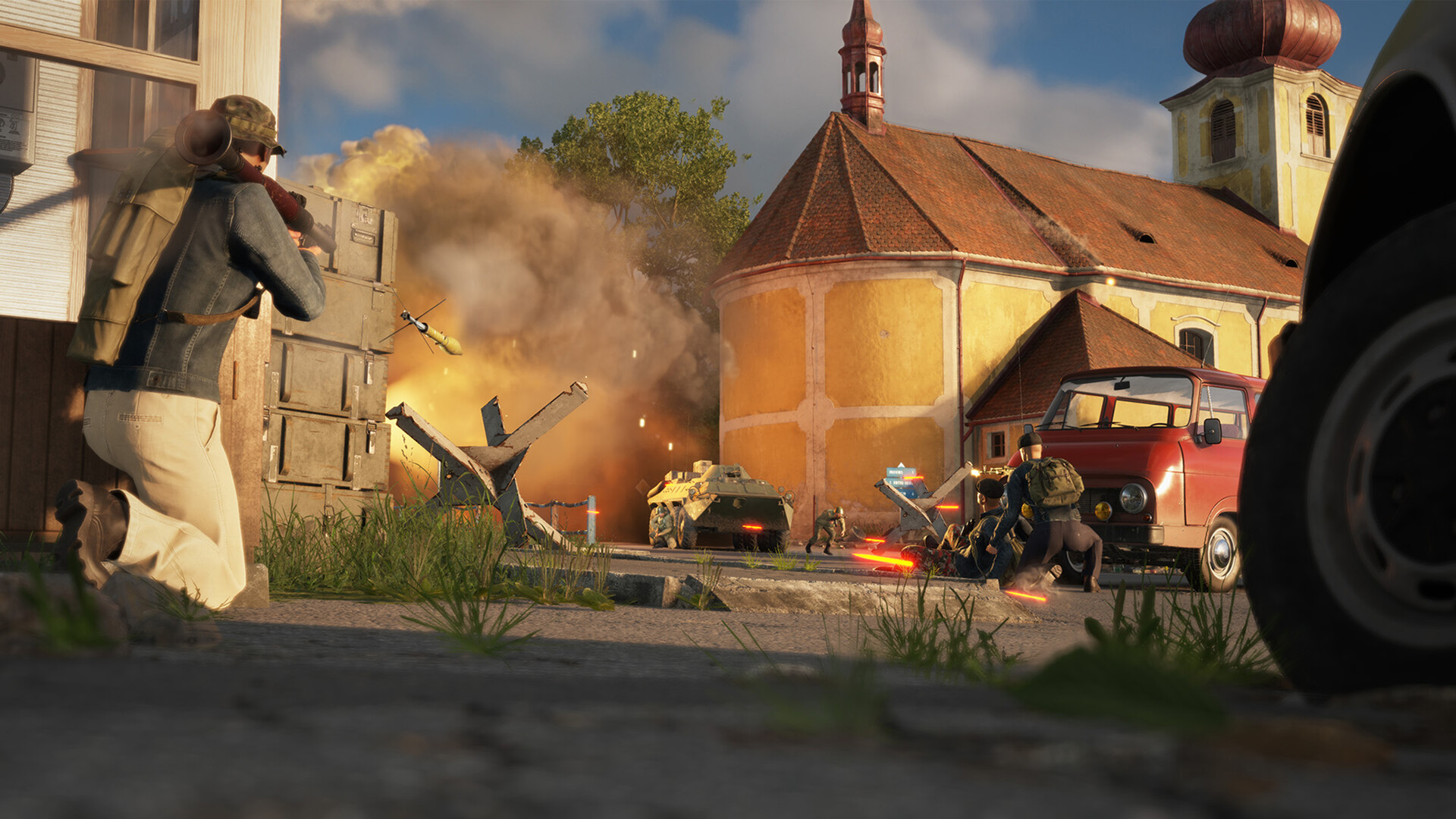
Arma Reforger’s Conflict mode rewards squads that split responsibilities across specialist roles. Unlike many shooters where everyone runs the same kit, Reforger punishes generic play: a squad with no anti-tank trooper loses vehicles unchecked, a squad with no radio operator loses respawn coverage, and a squad with no medic bleeds supplies every time someone goes down. This guide covers every major combat role — what they carry, why they matter, and how to play them effectively whether you are on the US Army or Soviet side.
How Roles Work in Arma Reforger
Arma Reforger does not enforce hard class locks the way many games do. Instead, roles are defined by your loadout, which you build or select in the Arsenal before spawning. Every item you take costs your team supplies — the shared resource pool that also funds vehicle spawns and base construction. Higher-tier gear, optics, and heavy weapons only become available as you climb the session-based Conflict ranks, earned by capturing objectives, deploying radios, healing teammates, and running logistics. The combination of supply cost and rank requirement creates natural role pressure: you cannot afford to kit everyone as a marksman, and you have not earned the Dragon launcher at Private rank anyway.
Running a dedicated Arma Reforger community server lets you adjust starting rank, supply rates, and faction balance to suit your group’s preferred pace and role composition.
Combat Roles at a Glance
| Role | US Primary Weapon | Soviet Primary Weapon | Key Contribution |
|---|---|---|---|
| Rifleman | M16A2 | AK-74 | Objective control, ammo sharing |
| Grenadier | M16A2 with M203 | AK-74N with GP-25 | Suppression, area denial |
| Machine Gunner | M60 | PKM | Sustained fire, pinning |
| Marksman | M21 DMR | SVD Dragunov | Long-range elimination, overwatch |
| Anti-Tank | M72 LAW | RPG-7 | Vehicle and armor threats |
| Medic | M16 Carbine | AKS-74U | Casualty care, supply efficiency |
| Engineer | M16A2 + toolkit | AK-74 + toolkit | Fortifications, vehicle repair, mines |
| Squad Leader / Radio Op | M16A2 + AN/PRC-77 | AK-74 + R-107M | Spawn coverage, command |
Rifleman
The Rifleman is the backbone of every squad and the best starting role for players learning the game. US riflemen carry the M16A2, which fires in burst or semi-automatic and is zeroed at 200 m by default. Soviet riflemen use the AK-74 — zeroed at 440 m — giving it a slight long-range default advantage at the cost of heavier recoil. Both rifles can accept optic attachments at higher ranks.
The Rifleman’s hidden value is ammunition sharing. Carrying extra magazines and distributing them to machine gunners, grenadiers, or other specialists in the field avoids costly respawn supply draws. As the cheapest loadout on the team, riflemen are also the most sustainable: dying and re-kitting consumes fewer resources than any specialist role.
Grenadier
The Grenadier adds an underbarrel grenade launcher to the rifleman’s baseline — the M203 on the M16A2 for US forces and the GP-25 on the AK-74N for Soviet troops. The 40 mm grenades excel at flushing enemies from cover, suppressing windows and doorways, and breaking up clustered infantry that would otherwise be difficult to engage with direct fire. Smoke rounds are also useful for covering movement. Ammunition for the launcher is limited per loadout, so grenadiers should coordinate with riflemen who carry reload packs.
Machine Gunner
Machine Gunners provide the squad’s suppressive fire platform. US gunners carry the belt-fed M60, and Soviet gunners carry the PKM. Both weapons feed from substantial belts, allowing long bursts that pin enemy infantry and force them behind cover while teammates maneuver. The weight of the weapon — particularly the M60 — noticeably slows movement, so MG gunners need squad escort rather than operating independently.
Deploying the weapon’s bipod on a wall, sandbag, or earthwork dramatically improves accuracy and reduces recoil. Any time the MG gunner sets up on a prepared position, they become far more effective than when firing from the hip or standing. Pair the Machine Gunner with a squad leader who can designate suppression targets, and read our fortifications guide for optimal firing positions to set up around.
Marksman
The Marksman role extends the squad’s engagement range and provides overwatch for assaults. US marksmen use the semi-automatic M21 DMR, fitted with a variable zoom riflescope adjustable between roughly 3x and 9x. Soviet marksmen carry the SVD Dragunov, whose scope includes a built-in rangefinding reticle. Both weapons require careful shot selection — magazines are limited compared to standard rifles.
Ranging is a critical skill for both platforms. The SVD scope lets you align horizontal reference lines against a standing target (soldiers measure approximately 1.7 m tall) to estimate range quickly. The M21’s scope bottom dot represents roughly 1 m at the scope’s reference magnification, enabling a similar technique. Marksmen should fire and relocate regularly, as sustained fire from one position gives away the squad’s flank. The gadgets and equipment guide covers rangefinders and binoculars that complement this role.
Anti-Tank (AT)
The AT role is the squad’s answer to enemy vehicles. US anti-tank troopers carry the M72 LAW, a single-use disposable rocket launcher. It handles lighter armored vehicles well, but the base game gives the US no dedicated heavy ATGM, so against tougher targets US AT players rely on flanking shots, explosives, or massed launchers. Soviet AT troopers use the RPG-7, which is reusable and accepts the PGO-7 scope and PG-7VM warheads — a meaningful tactical advantage in sustained engagements where resupply is available.
The single most important AT safety rule is backblast awareness. Firing either launcher with friendly troops in the danger zone directly behind the weapon is lethal. Always call out “firing” and ensure clear space to the rear before engaging. AT troopers should position themselves with a clear exit route after firing, as the signature of a rocket launch will attract immediate enemy attention.
Medic
Medics are arguably the highest-impact role in Conflict mode because every casualty they bring back saves a full loadout’s worth of supplies. US medics typically run the M16 Carbine for a lighter primary; Soviet medics carry the compact AKS-74U. Both trade some range capability for the ability to carry a larger medical kit. A standard medic loadout prioritizes bandages, morphine, tourniquets, and saline — applied in that order during treatment. Keep smoke grenades for self-cover when treating downed teammates under fire, and leave fragmentation grenades behind if weight permits.
Engineer
Engineers are the most underrated role in public Conflict matches. Their toolkit enables basic vehicle repairs, mine detection with a minesweeper, and mine defusing. When near a Command Post or construction vehicle, an engineer equipped with an entrenching tool can construct fortifications — sandbag walls, bunkers, and other defensive structures appear as white ghost outlines within roughly 25 m, and the BUILD interaction starts construction. A well-fortified objective can hold against multiple assaults and is extremely supply-efficient compared to repeatedly respawning defenders.
Note that in Reforger, any soldier can disarm a mine — the game removed the previous Arma series restriction that required an engineer class for that task. However, engineers are still better equipped for minefield clearance thanks to the minesweeper speed bonus.
Radio Operator and Squad Leader
No other single role affects the entire team’s ability to fight as directly as the Squad Leader or Radio Operator carrying a manpack radio. US squads use the AN/PRC-77 (9 kg, approximately 2 km range); Soviet squads carry the R-107M (heavier, dual transceivers, similar range). When the radio operator is alive and within signal range of friendly positions, teammates can respawn directly on their location — avoiding the long run-in from a distant base.
The radio backpack occupies the entire backpack slot, which is a significant tradeoff: the operator carries less ammunition and fewer supplies. This makes them dependent on the squad for protection. Higher operator rank increases the frequency at which teammates can respawn at that position. Radios can be recovered from fallen operators and re-deployed, so protecting or retrieving the radio is often more tactically valuable than the operator themselves. Read the full radio communications guide to master frequency management and multi-squad coordination. Setup documentation for your own server is available at xgamingserver.com/docs/arma-reforger.
Role Composition Tips for Squad Leaders
- A balanced four-person fire team covers: one Rifleman (ammo), one Medic, one specialist (AT or MG depending on terrain), and one Radio Op / Squad Leader.
- Urban maps and close-quarter objectives favor Grenadiers and Medics over Marksmen.
- Open terrain assaults benefit from a Marksman providing suppressive overwatch while the team bounds forward.
- Never send your only AT trooper without escort — a lone AT operator with no flanker protection rarely survives long enough to engage a vehicle.
- Supply discipline matters: if your base is running low, switch heavier roles to basic Rifleman until resupply arrives.
Frequently Asked Questions
Can I change my role mid-game in Arma Reforger?
Yes — you re-kit whenever you respawn by visiting the Arsenal at a base or supply point. There are no permanent class commitments. If your squad’s needs change (for example, a vehicle appears and you have no AT coverage), the next death is an opportunity to switch loadout. Bear in mind the supply cost: switching to a heavier specialist role consumes more team resources per spawn.
Which role is best for beginners in Conflict mode?
Start with Rifleman. The M16A2 or AK-74 are forgiving, the supply cost is low, and the role teaches core mechanics — movement, cover, fire discipline, and medical self-treatment — without the pressure of a specialist job. Once you are comfortable with the basics, Medic is the highest-impact next step because experienced healing has an outsized effect on your team’s sustainability.
Does the RPG-7 have a backblast danger zone?
Yes. Both the RPG-7 and the US M72 LAW produce a dangerous backblast behind the launcher when fired. Friendly troops standing directly behind the weapon within the danger zone will be seriously wounded or killed. Always check your six before firing, call out to squadmates, and never fire inside a confined space with allies nearby. This is one of the most common causes of friendly-fire casualties for new AT operators.
Ready to play?
Run your own Arma Reforger server with XGamingServer
Spin up an always-on Arma Reforger server your friends can join in minutes — no port-forwarding, no tech headaches.