Building is the heart of Valheim, and a good base is more than decoration — it keeps you rested, safe from raids, and gives you a hub to launch expeditions from. But the building system has real rules around structural integrity, comfort and defence that trip up new players. This guide covers everything you need to build a base that actually stands up and keeps the enemies out.
The two things every base needs
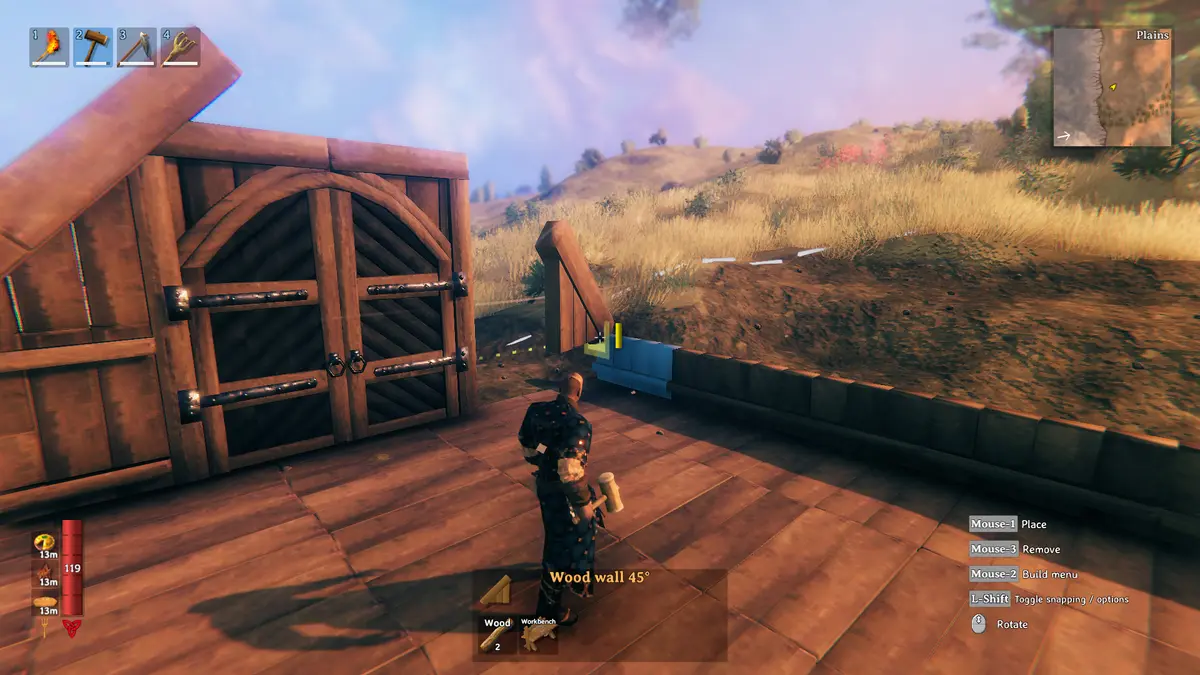
You build with the Hammer (right-click to open the build menu) and you need a Workbench nearby to place most pieces. The workbench has a second, crucial job: monsters can’t spawn inside its radius. Placing workbenches (and later, other crafting stations) around your base perimeter is the simplest way to stop enemies appearing inside your walls. Keep them sheltered and repaired or their suppression area shrinks.
Structural integrity: why your builds collapse
Valheim simulates structural support. Every building piece has integrity based on how many pieces it is from the ground — the further it stretches out or up unsupported, the weaker it gets. Equip your Hammer and hover over a piece: it colours from blue (strongest) → green → yellow → red (about to fall).
Two practical rules follow from this:
- Use core wood beams and poles to reinforce. A single large beam or pole carries integrity a long way — a vertical iron pole can rise up to ~50m before it can’t support anything above it.
- Upgrade your materials for height. Stone is far stronger than wood for foundations and tall structures, and iron-reinforced pieces beat plain wood. Build big bases on stone footings.
Comfort and the Rested buff
The single most important reason to build a home is the Rested buff, which boosts health regeneration by 50% and stamina regeneration by 100%. Its duration scales with your Comfort level, which you raise by placing different comfort items near a fire: a fire, a roof and shelter, a bed, a banner, a chair or throne, a table, rugs, and so on. Each unique item adds a comfort point. A cosy base with high comfort gives you a long Rested buff that makes everything — combat, mining, sailing — faster.
Core checklist for a comfortable home: fire (ventilated through a hole in the roof or smoke kills you), a covered roof so it stays dry, a bed to set your spawn, and a handful of comfort furniture.
Defending against raids
Once you progress, the game sends raids — “the ground is shaking” events — against your base. The best defences, in order of effectiveness:
- The moat. Digging a trench around your base is the gold standard. Make it at least 4–5 pickaxe-depths deep and wide enough that enemies can’t path across — most ground enemies simply get stuck and can’t reach you. Beware: trolls swinging logs have ~8m reach, so keep buildings set back from the edge.
- Raised earth walls. Use the Hoe’s “raise ground” to build earthen ramparts. Earth walls are extremely durable and enemies can’t climb or destroy them easily — combine with a moat for a near-impenetrable perimeter.
- Stake walls and stone walls. Good secondary layers; stone walls resist most attacks, while sharp stakes add damage.
- Stake traps. Place sharpened stakes where enemies path — they damage anything that touches them with zero input from you.
A moat plus an earth wall is the classic raid-proof combo and will see you safely through every event in the game.
Picking a base location
The best base spots balance safety and resources. Look for: a Meadows area (safe, buildable) near the coast for boat access, close to a Black Forest for copper and a river for transport. A small peninsula or island makes moating trivial since water does half the work. Build near — but not in — the biomes you’re actively farming to cut travel time.
Smart building tips
- Vent your fires or smoke will suffocate you — leave a roof gap or use a chimney design.
- Build a portal hub. A wall of tagged portals at home lets you fast-travel to every outpost you’ve explored.
- Raise the ground under your floor to stop water and to flatten uneven terrain cleanly.
- Separate storage and crafting into a workshop wing so stations don’t clutter your living space — stations need clearance to be used and upgraded.
Keep your base online with a dedicated server
A great base is only as good as the world it lives in. On peer-to-peer, your build is offline whenever the host isn’t playing. A Valheim dedicated server keeps your world — and everyone’s builds — online 24/7, so the whole crew can keep expanding the base any time, on any platform, with full crossplay arriving at the 1.0 launch on September 9, 2026. Tune raid frequency and more with our server config generator.
Frequently asked questions
How do I stop my base collapsing in Valheim?
Support tall or wide structures with core wood beams and poles, and use stronger materials (stone, iron-reinforced) for foundations. Hover with the Hammer to check the integrity colour of each piece.
How do I make a raid-proof base?
Dig a moat 4–5 pickaxe-depths deep around your base and add a raised earth wall. Most enemies can’t cross either, making the combo effectively raid-proof.
How do I stop enemies spawning in my base?
Place workbenches and other crafting stations around your perimeter — monsters can’t spawn within their radius.
What gives the Rested buff?
Comfort items near a fire and shelter. Each unique item (bed, chair, table, banner, rug, etc.) adds comfort, which lengthens the Rested health/stamina regeneration buff.
Ready to play?
Run your own Valheim 1.0 server with XGamingServer
Spin up an always-on Valheim 1.0 server your friends can join in minutes — no port-forwarding, no tech headaches.