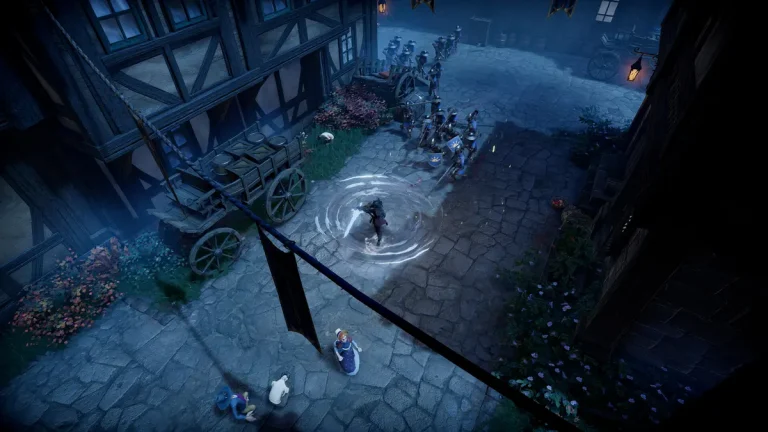

Picking the right spells in V Rising is one of the biggest power spikes available to your vampire, and it is entirely driven by how you hunt and harvest V Blood from bosses. Each of the game’s six spell schools has a distinct identity, a different way of controlling fights, and a different payoff in solo, co-op, and PvP. This guide breaks down all six schools as they exist in the current 1.1 “Invaders of Oakveil” update (the large free content layer that arrived in 2025), explains exactly how spells unlock, how Spell Jewels reshape them, and which abilities the community tends to favor. If you are running your own server and want to experiment freely with respecs and progression, a low-latency dedicated V Rising server makes it painless to test builds with friends.
How spells unlock in V Rising
Spells in V Rising are not bought, crafted, or found in chests. They are earned by harvesting V Blood from V Blood bosses. When you defeat one of these named bosses and drain its powerful blood, you are rewarded with a Spell Point tied to a specific discipline and tier. Those Spell Points are the currency you spend to unlock the abilities within each school.
Spell Points come in three tiers: Tier 1, Tier 2, and Tier 3. Lower-tier bosses grant lower-tier points, and you spend the matching tier of point to unlock the matching tier of spell in a school. This means your spell selection scales naturally with your progression through the map. As you push from Farbane Woods into Dunley Farmlands, Silverlight Hills, and the Gloomrot region, the bosses you defeat hand you progressively higher-tier Spell Points, opening up the more advanced abilities in each school.
The practical upshot is that your build is shaped by which bosses you choose to fight and in what order. There is no single locked path. You can mix and match across schools, swap your equipped spells at any time, and respec freely to suit a particular fight or PvP encounter.
The six spell schools at a glance
V Rising has six spell schools: Blood, Chaos, Frost, Illusion, Unholy, and Storm. The Storm school was a later addition that arrived with the Secrets of Gloomrot content layer, alongside the Gloomrot region. Here is how each school plays at a high level before we dig into the details.
| School | Core identity | Signature effect |
|---|---|---|
| Blood | Damage plus self-sustain | Inflicts Leech (drains and heals you) |
| Chaos | Hard-hitting burst | Inflicts Ignite (damage over time) |
| Frost | Control and lockdown | Chill and freeze enemies |
| Illusion | Specters and debuffs | Weaken (-15% enemy damage), chance of Phantasm |
| Unholy | Summons and execution | Condemn (+15% damage to target) |
| Storm | Area-of-effect clear | Strong AoE that snowballs late game |
Blood school: the self-sustain school
The Blood school is built around the dual goal of dealing damage while keeping yourself alive. Its defining mechanic is Leech: Blood spells apply a leech effect that lets you drain life from enemies you damage, turning sustained fights into a war of attrition that favors you. This makes Blood an outstanding pick for solo players who cannot rely on a teammate to peel pressure off them, and for prolonged boss fights where the incoming damage is steady rather than spiky.
Blood pairs naturally with the Scholar or Brute blood types depending on whether you want spell power or raw survivability. Because the school is so self-sufficient, it tends to forgive mistakes: a missed dodge that would kill a glass-cannon Chaos build is often something a Blood vampire can simply heal through. If you want to understand how to maximize the leech and healing payoff, our companion piece on why blood types matter in V Rising explains how blood quality amplifies these effects.
Chaos school: burst and burn
Chaos is the aggressive damage school. Its abilities hit hard up front and apply Ignite, a damage-over-time burn that continues to tick after the initial impact. The combination of high burst plus a lingering DoT makes Chaos excellent at quickly stacking damage on a single priority target. In PvP, the burn pressure forces opponents to disengage or commit to healing, and in PvE it shreds bosses that you can keep at range.
The trade-off is that Chaos offers little in the way of self-protection. It does not heal you, it does not lock enemies down for long, and a Chaos vampire that gets caught out of position is fragile. This is the school for players who want to win fights by ending them fast, and it rewards good positioning and timing over patience. Pair it with crit-focused or spell-power blood for maximum burst.
Frost school: control and crowd management
Frost is the dedicated control school. Its spells chill and freeze enemies, slowing their movement and locking them in place. The standout example is Frost Vortex, which pulls enemies toward a point while chilling them, bunching up a group so you can punish them with follow-up damage. Freezing a target outright is one of the strongest defensive tools in the game: a frozen enemy cannot attack, dodge, or cast.
Frost shines in two scenarios. In PvP it neutralizes aggressive opponents, buying you time to reposition or letting a teammate land a kill on a frozen target. In PvE it gives kiting builds the breathing room they need against fast or numerous enemies. Frost does less raw damage than Chaos or Unholy, so most players run it as a control tool alongside a damage-oriented primary weapon, rather than as a pure DPS school.
Illusion school: debuffs and specters
Illusion is the trickster school, built around summoning specters and weakening enemies. Its signature debuff is Weaken, which reduces the affected enemy’s damage output by 15% — a meaningful defensive swing in a long fight or a group brawl. Illusion spells also carry a chance to grant you Phantasm, a buff that reduces your spell cooldowns and lets you cast more often.
That cooldown-reduction loop is what makes Illusion deceptively strong: the more you cast, the more often Phantasm procs, the more you can keep casting. It is a school that rewards engagement and uptime rather than burst windows. The Weaken debuff also makes Illusion a strong support pick in co-op, where reducing a boss’s damage by 15% protects your whole team. If you are coordinating a group, hosting on a private server with friends — see our walkthrough on setting up a V Rising dedicated server — lets you assign roles like an Illusion support and a Chaos damage dealer.
Unholy school: summons and execution
Unholy is the necromancer school. It revolves around summoning minions to fight alongside you and applying Condemn, a debuff that increases the damage the target takes by 15%. The synergy is dark and effective: when a condemned enemy dies, it spawns an unholy warrior to join your ranks, turning kills into reinforcements. A wave of summons plus a damage-amplifying debuff makes Unholy a force multiplier that snowballs the longer a fight goes.
This school is particularly strong in PvE and against groups, where the summons can soak damage and apply pressure while you focus your own attacks on priority targets. The +15% damage from Condemn also stacks meaningfully into single-target burst, so Unholy is flexible enough to handle both crowds and bosses. Community discussion frequently points to Unholy’s Void spell as a top-tier area-damage and group-pull tool, though as with all meta picks this should be treated as opinion that shifts with each patch.
Storm school: late-game AoE clear
Storm arrived with the Secrets of Gloomrot content and is the area-of-effect specialist. Its defining trait is strong AoE damage that snowballs in the late game, making it the go-to school for clearing dense groups of enemies — for example during Rift events and other moments where you are swarmed. Storm rewards players who have progressed far enough to access its higher-tier abilities, where the AoE output becomes genuinely overwhelming.
Early on, Storm can feel less impactful than the more single-target-focused schools, which is why many players adopt it as a secondary or endgame option rather than a starting choice. Once your gear and Spell Points catch up, however, it becomes one of the most efficient PvE-clear tools available.
Spell Jewels: customizing your non-ultimate spells
The second layer of spell customization comes from Spell Jewels. These are crafted at the Jewelcrafting Table and they modify all non-ultimate spells, changing their effects, scaling, and behavior. A jewel might add an extra effect, alter the cast pattern, or boost a stat, letting you fine-tune a spell to fit your build rather than taking it as-is.
Spell Jewels are made from refined gems, and there is an important catch: you cannot use crude gems directly in Spell Jewels. Crude gems are the lowest tier of gemstone, and they must first be refined into regular or Flawless quality at the Gem Cutting Table before they can go into a jewel. The Gem Cutting Table is unlocked by defeating Terah the Geomancer, a V Blood boss in Bedrock Pass, Dunley Farmlands, and it upgrades gems at a ratio of four lower-tier into one higher-tier (for example, four Crude Amethyst become one Amethyst). For the full mining-to-jewel pipeline, our guide to V Rising crude gems covers where to farm nodes and how the refining chain works.
Because jewels only affect non-ultimate spells, your school’s ultimate ability remains a fixed centerpiece while the rest of your kit becomes highly tunable. This is where a lot of the depth in late-game build crafting lives, and it is one of the main reasons two players running the same school can feel completely different in combat.
Meta picks: which spells the community favors
It is worth being clear that “best spells” in V Rising is a moving target. The community meta shifts with every patch, and what dominates one season can be tuned down the next. With that caveat firmly in mind, here are the picks that have tended to draw praise — treat these as opinion and a starting point, not as fixed truth.
- Void (Unholy) — frequently cited for its strong area damage combined with a group-pull effect, making it excellent against crowds.
- Frost Vortex (Frost) — the premier control tool, pulling and chilling enemies to set up follow-up damage or peel for teammates.
- Blood school spells — favored for sustain, especially when boosted by the 1.0-era Awakening systems that amplify vampiric effects.
- Storm spells — the consensus choice for late-game AoE clear when you need to delete dense waves of enemies.
The smartest approach is not to chase a single “best” loadout but to match your school to your situation. Run Blood or Illusion when you need to survive and sustain, Chaos or Unholy when you need to delete a target, Frost when you need control, and Storm when you need to clear. On your own server you can respec and experiment without judgment, which is the fastest way to find what actually clicks for your playstyle.
Practicing builds on your own server
If you want to test spell schools without grinding a public server’s rules, running your own dedicated server gives you total control over progression, drop rates, and respawn timers. V Rising’s dedicated server is officially a Windows-only tool (Stunlock does not ship a native Linux build; Linux hosting only exists through community Wine/Proton wrappers). You install it anonymously through SteamCMD using the dedicated server app ID, which is separate from the game client:
login anonymous
app_update 1829350 validate
quit
For reference, the game client app ID is 1604030 and the dedicated server tool app ID is 1829350. After install you will find start_server_example.bat in the folder; the official recommendation is to copy it to start_server.bat, set at minimum a serverName, and run the server once to generate its config files. Gameplay rules — including XP, drop, and yield multipliers that affect how fast you unlock Spell Points — live in ServerGameSettings.json, while network and identity settings live in ServerHostSettings.json. The default ports are 9876 for game traffic and 9877 for the Steam query port. Our guide to configuring your V Rising server walks through the multipliers in detail, and the full V Rising server documentation covers everything from RCON to backups.
One important warning if you are experimenting heavily: wiping your server is destructive. A wipe is performed by deleting the save folder under Saves\v4\ in the persistent data path (note it is v4 on current 1.1.x builds, not the older v3), or by changing SaveName to spawn a fresh world. Either way it permanently removes all castles, every player’s vampire and progression, and the world state. Always copy the entire Saves\v4\ folder elsewhere before you wipe — auto-saves live inside that folder and are deleted along with it, so they are no help once it is gone.
Frequently asked questions
How do I unlock new spells in V Rising?
You unlock spells by harvesting V Blood from V Blood bosses. Each boss you defeat grants a Spell Point in a specific discipline at Tier 1, 2, or 3, and you spend those points to unlock the abilities within a school. There is no other way to acquire spells — they are tied entirely to boss progression.
How many spell schools are there?
There are six spell schools: Blood, Chaos, Frost, Illusion, Unholy, and Storm. Storm was added with the Secrets of Gloomrot content alongside the Gloomrot region, while the other five have been present since earlier in the game’s life.
What is the best spell school in V Rising?
There is no single best school — it depends on your situation and the current patch. Blood and Illusion excel at sustain and support, Chaos and Unholy at deleting targets, Frost at control, and Storm at late-game AoE clear. Community favorites like Unholy’s Void and Frost’s Frost Vortex are strong starting points, but treat any “best” list as opinion that shifts with balance updates.
What do Spell Jewels do?
Spell Jewels, crafted at the Jewelcrafting Table, modify all of your non-ultimate spells — changing their effects, scaling, and behavior. They are made from refined gems, so you must first upgrade crude gems to regular or Flawless quality at the Gem Cutting Table; crude gems cannot be slotted into jewels directly.
Can I respec my spells?
Yes. You can swap your equipped spells and change schools freely, which makes experimentation low-risk. Running your own server is the easiest way to test multiple builds quickly, since you control progression speed and can adjust gameplay multipliers to unlock Spell Points faster.
Does the current 1.1 update change spells?
The 1.1 “Invaders of Oakveil” update (released in 2025) added seven new spells, including a Megara-shard ultimate tied to the new Serpent Queen boss, along with three new weapons and a reworked blood system that introduced Corrupted Blood. The six-school framework remains the same; Oakveil expands the options within it rather than replacing the structure.
Ready to play?
Run your own V Rising server with XGamingServer
Spin up an always-on V Rising server your friends can join in minutes — no port-forwarding, no tech headaches.