Configuring a V Rising server looks simple on the surface — two JSON files, a restart, done. But the single most common mistake new admins make is editing the wrong copy of those files, watching their changes vanish on the next update, and assuming the config is broken. It isn’t. You just edited a template instead of the live save. This guide walks through exactly which files V Rising reads, what every important field does, and how to apply your changes so they actually stick. Everything here is verified against Stunlock’s official dedicated-server instructions for the current 1.1 “Invaders of Oakveil” release (the large free update that landed April 28, 2025) and reflects the 1.1.x-pc server branch.
The two config files V Rising uses
A V Rising dedicated server is driven by exactly two JSON config files, and understanding the split between them is the foundation for everything else:
- ServerHostSettings.json — your server’s identity and network layer: name, description, ports, player and admin caps, password, save name, server list visibility, auto-save behavior, and the RCON block.
- ServerGameSettings.json — the gameplay rules: PvP vs PvE, clan size, castle damage windows, and dozens of multipliers that control crafting speed, blood drain, resource yields, and inventory stacking.
If you have not stood the server up yet, start with our companion walkthrough on setting up your V Rising dedicated server, then come back here to tune it. As a quick recap, the server installs anonymously through SteamCMD using the dedicated-server tool app ID 1829350 (the game client itself is app ID 1604030, which you do not need on the host):
login anonymous
app_update 1829350 validate
quit
After install you’ll find VRisingServer.exe and a start_server_example.bat. Stunlock recommends copying that batch file to start_server.bat, setting at least a server name, and running the server once so it generates the config files before you customize anything. One important reality check: the server is Windows-only. Stunlock’s instructions explicitly state there is currently only a Windows build of the server. There is no officially supported native Linux binary — Linux hosting only exists through community Wine/Proton wrappers, which is something your host handles transparently, not something Stunlock targets.
The folder that actually matters: persistent-data vs StreamingAssets
This is the part that trips up almost everyone, so read it carefully. There are two locations on disk where the config files live:
- Template copies sit inside the install folder at
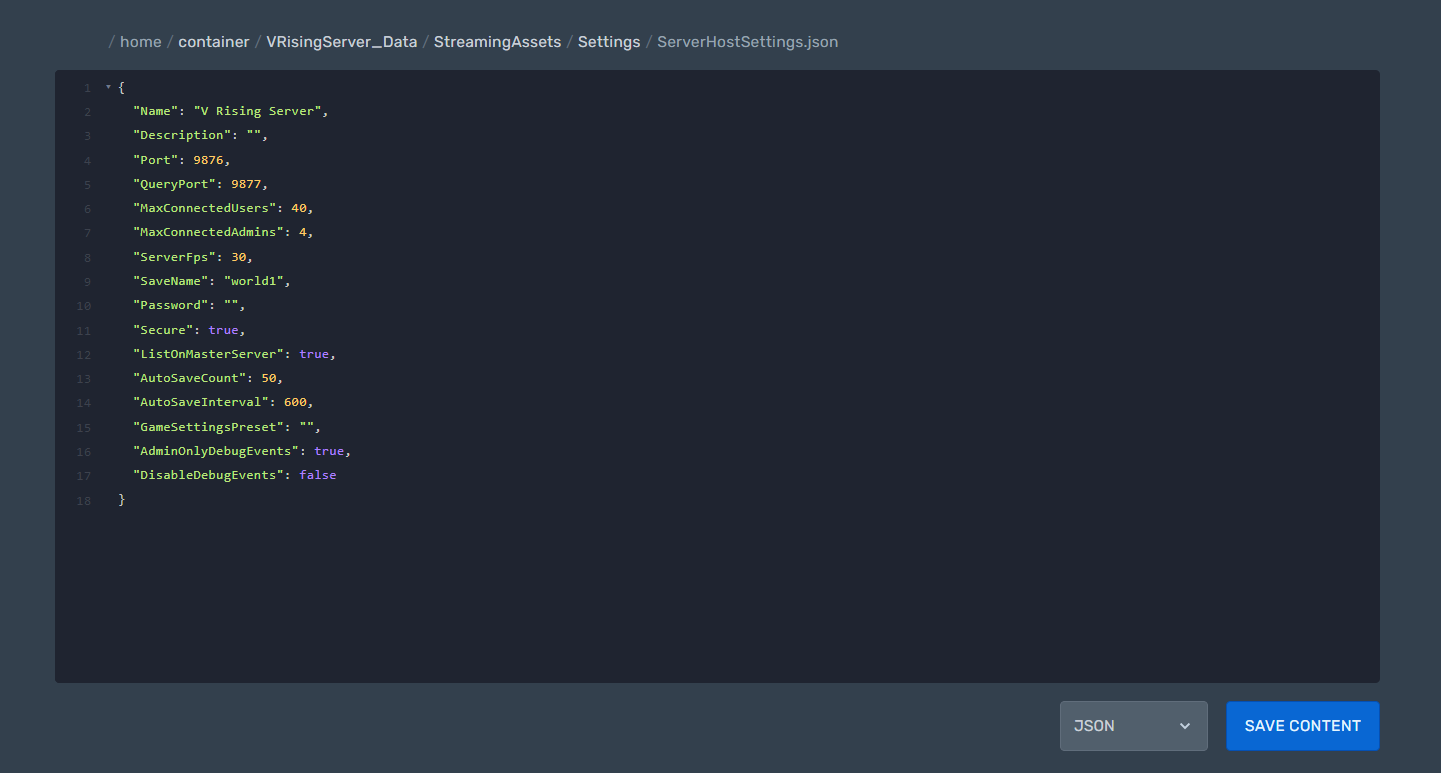
VRisingServer_Data/StreamingAssets/Settings/. These are defaults. They get overwritten on every game or server update, and the running server does not read them. Do not edit these. - Active copies live in the persistent-data path. On a default Windows install that is
%USERPROFILE%\AppData\LocalLow\Stunlock Studios\VRisingServer\Settings\. This path can be redirected with the-persistentDataPathlaunch parameter, which is exactly what managed host panels do — they point it at asave-data/folder you can see in your file manager.
The rule is simple: edit the active copy in the persistent-data Settings/ folder. On a hosting panel that’s typically save-data/Settings/ServerHostSettings.json and save-data/Settings/ServerGameSettings.json. If your edits keep disappearing, you were almost certainly editing the StreamingAssets template — switch to the persistent-data copy and the problem goes away.
Configuring ServerHostSettings.json
This file defines how players find and connect to your server. Here are the verified default fields and their out-of-the-box values:
| Field | Default | What it does |
|---|---|---|
Name | “V Rising Server” | The name shown in the server browser. |
Description | “” | Free-text blurb shown to players. |
Port | 9876 | Main game traffic port. |
QueryPort | 9877 | Steam server-list query port (UDP). |
MaxConnectedUsers | 40 | Maximum simultaneous players. |
MaxConnectedAdmins | 4 | Reserved admin slots beyond the cap. |
ServerFps | 30 | Server simulation tick target. |
SaveName | “world1” | Names the world save folder. |
Password | “” | Empty = open; set a string to lock the server. |
Secure | true | Enables anti-cheat/secure mode. |
ListOnMasterServer / ListOnSteam / ListOnEOS | true | Public server-browser visibility toggles. |
AutoSaveCount | 50 | How many auto-saves to retain. |
AutoSaveInterval | 600 | Seconds between auto-saves (10 minutes). |
A minimal, sensible host settings file for a private password-protected server looks like this:
{
  "Name": "Oakveil Coven",
  "Description": "Private PvE server - friends only",
  "Port": 9876,
  "QueryPort": 9877,
  "MaxConnectedUsers": 16,
  "MaxConnectedAdmins": 4,
  "ServerFps": 30,
  "SaveName": "world1",
  "Password": "BloodMoon2026",
  "Secure": true,
  "ListOnMasterServer": false,
  "ListOnSteam": true,
  "ListOnEOS": true,
  "AutoSaveCount": 50,
  "AutoSaveInterval": 600
}
A critical port note: V Rising’s real defaults are 9876 (game) and 9877 (query). You will sometimes see guides cite 27015/27016 — those are generic Steam defaults and are not V Rising’s. Whatever Port and QueryPort you set must be open and forwarded (UDP) or players cannot connect, and the server may not list. If you ever change Port or QueryPort, update your firewall/port-forward rules to match.
Configuring ServerGameSettings.json
This is where you shape the actual experience. The most consequential fields:
GameModeType—"PvP"enables player-versus-player combat;"PvE"disables it so players cannot harm each other. A Duo PvP mode also exists for two-player teams.ClanSize— defaults to 4. Private servers can push this up to around 50. (Duo mode locks clans to 2.)CastleDamageMode—"Always"(castles can be raided any time),"Never"(castles are invulnerable — common on PvE), or"TimeRestricted"(raids only during configured windows).- Multipliers — fields like
CraftRateModifier,BloodDrainModifier,MaterialYieldModifier_Global, andInventoryStacksModifierscale the grind. The server falls back to built-in defaults for any key you omit, so you only need to include the ones you want to change.
A relaxed PvE-friendly snippet that speeds up the early grind without breaking progression:
{
  "GameModeType": "PvE",
  "ClanSize": 6,
  "CastleDamageMode": "Never",
  "CraftRateModifier": 1.5,
  "MaterialYieldModifier_Global": 1.5,
  "InventoryStacksModifier": 2.0,
  "BloodDrainModifier": 0.75
}
For a hardcore raiding server you’d instead set "GameModeType": "PvP" and "CastleDamageMode": "TimeRestricted" so castles are only vulnerable during scheduled raid windows — a popular balance that lets players defend without being offline-raided around the clock.
Using GameSettingsPreset
Rather than hand-tuning every multiplier, ServerHostSettings.json exposes a GameSettingsPreset field. Set it to a named preset and the server loads that preset’s full ruleset — Stunlock ships templates corresponding to standard PvP, standard PvE, Duo, and harder difficulty profiles. The exact preset string names should be read from your live config file rather than copied blindly, since they can vary by version; the mechanism itself is reliable. If you set a non-empty preset, it governs the gameplay rules, so use either a preset or a fully hand-edited ServerGameSettings.json to avoid confusion.
How settings actually apply
V Rising loads its configuration at boot. There is no hot-reload. Your workflow is always:
- Stop the server.
- Edit the JSON in the persistent-data
Settings/folder (thesave-data/Settings/copy, never StreamingAssets). - Validate your JSON — a single missing comma or stray quote will cause the file to fail to parse, and the server falls back to defaults. Paste it into a JSON validator if anything looks off.
- Start the server. Your changes are now live.
If a setting “didn’t take,” the cause is almost always one of three things: you edited the StreamingAssets template, the JSON was malformed and silently reverted to defaults, or you forgot to restart. Check those in order.
Enabling RCON for remote administration
RCON lets you issue admin commands remotely — kicks, bans, broadcasts, and automation — without being in-game. It’s configured through the Rcon object inside ServerHostSettings.json:
"Rcon": {
  "Enabled": true,
  "Password": "yourStrongPassword",
  "Port": 25575
}Enabledmust betrue.Passwordis mandatory — RCON refuses connections without one, so never leave it blank.Portdefaults to 25575 (TCP), the standard Source-style RCON port.
Connect using any standard RCON client — mcrcon, rcon-cli, or a web-based RCON panel — with your server IP, the RCON port, and the password. Remember to open/forward that TCP port. For a step-by-step with screenshots, see our dedicated guide on how to enable RCON on your V Rising server.
Wiping the server ⚠️ destructive
A wipe permanently destroys world progress and cannot be undone without a backup, so treat this section with care. Your save data lives under the persistent-data path at Saves\v. For the current 1.1.x server, the persistence version folder is v4 — not v3, which older guides reference. On a default Windows install that’s:
%USERPROFILE%\AppData\LocalLow\Stunlock Studios\VRisingServer\Saves\v4\\ On a hosting panel this is exposed as save-data/Saves/v4/. There are two clean ways to wipe:
- Delete the
Saves\v4\and restart. The server generates a brand-new world. - Change
SaveNameinServerHostSettings.jsonto a new value. The server starts a fresh world while leaving the old save untouched on disk — a non-destructive way to “reset” that keeps the option to switch back.
A wipe removes everything for that save: all castles and castle hearts, every player vampire character and their progression (gear, V Blood unlocks, research), and the entire world state. Auto-saves do not protect you here — they live inside the save folder and are deleted right along with it.
Always back up first. Before any wipe, copy the entire Saves\v4\ folder somewhere safe. That single copy is your only insurance against an accidental, irreversible loss. For the full procedure including scheduled wipes, see how to wipe your V Rising server.
Where this fits in the bigger picture
Config is half the battle; the other half is what your players experience once they’re in. If you’re tuning blood-drain rates, it helps to understand the underlying V Rising blood types and why they matter — the 1.1 Oakveil update reworked the blood system and added Corrupted Blood, which changes how players chase high-quality blood. And once your world is live, players will want to know about strong base locations across Farbane, Dunley, and Silverlight.
Running all of this on the right hardware makes a real difference, especially the ServerFps target and player cap. If you’d rather skip SteamCMD, port forwarding, and persistent-data path juggling entirely, our managed V Rising server hosting exposes both JSON files directly in the panel with the persistent-data path already wired up correctly, so your edits always hit the live save. You can also dig into the full configuration reference in the V Rising documentation.
Frequently asked questions
Why do my config changes disappear after an update?
You’re editing the wrong copy. The files in VRisingServer_Data/StreamingAssets/Settings/ are templates that get overwritten on every update, and the server doesn’t read them anyway. Edit the active copies in the persistent-data Settings/ folder (on a panel, save-data/Settings/) and your changes will persist.
What ports does V Rising use?
Game traffic uses port 9876 and the Steam query uses 9877 by default. RCON, if enabled, defaults to TCP 25575. Ignore any guide citing 27015/27016 — those are generic Steam defaults, not V Rising’s.
How do I switch my server between PvP and PvE?
Set GameModeType in ServerGameSettings.json to "PvP" or "PvE", then restart the server. On PvE you’ll usually also want CastleDamageMode set to "Never" so castles can’t be raided.
Do I need to restart the server for changes to take effect?
Yes. V Rising loads its configuration at boot and does not hot-reload. Always stop the server, edit the JSON, then start it again.
Can I run a V Rising server on Linux?
There’s no official native Linux server — Stunlock only ships a Windows build. Linux hosting exists only through community Wine/Proton wrappers, which managed hosts handle for you behind the scenes. There’s no separate Stunlock Linux binary to install.
How do I wipe my server without losing everything by accident?
Back up first: copy the entire Saves/v4/ folder somewhere safe. Then either delete the SaveName in ServerHostSettings.json to start a fresh world while keeping the old save on disk. Auto-saves live inside the save folder, so they won’t survive a delete.
Ready to play?
Run your own V Rising server with XGamingServer
Spin up an always-on V Rising server your friends can join in minutes — no port-forwarding, no tech headaches.