Every Rust wipe puts you back to zero: naked on a beach with a rock and a torch. The journey from that naked spawn to an AK-47 and a stack of explosives follows a clear arc, and understanding it is the difference between thriving and getting farmed. This guide walks the full progression ladder — gathering, your first base and tool cupboard, the workbench tiers, scrap and the tech tree, guns, monuments and finally raiding — so you always know what to chase next. Exact item costs and stats change with Rust’s monthly updates, so where a number matters we flag it as version-dependent; treat the values here as recent-patch reference, not gospel.
Stage 1: Wipe Day and the Naked Phase
You spawn with a rock, a torch and an empty stomach. The rock can punch trees, ore nodes and animals, but it gathers slowly. Your first priority is wood and stone so you can craft a stone hatchet (your wood-gathering tool) and a stone pickaxe (faster on ore nodes), which gather noticeably faster than the rock. When you hit a node, watch for the bright sparkle marker on the rock face — landing your swings on that spot increases your yield, and breaking the node finishes it for bonus resources.
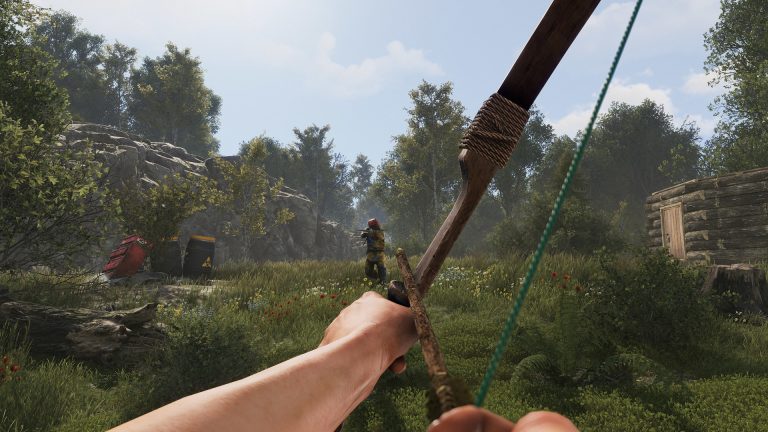
Spawning coastal or forest rather than roadside keeps you away from early traffic. Grab a wooden spear or bow for self-defense and food, and start hitting barrels and crates along roads — those drop the components and scrap you’ll live on. Keep an eye on hunger, thirst and radiation; if survival mechanics feel unfamiliar, the Rust Survival Guide: Radiation, Temperature, Comfort and Hydration covers staying alive while you farm, and the Rust Hunting & Food Guide covers feeding yourself early.
Stage 2: First Base and the Tool Cupboard
Nothing you gather is safe until you have walls and a Tool Cupboard (TC). Place the TC inside your first enclosed room and authorize yourself to it by pressing the Use key (default E). The TC grants building privilege within roughly 50 meters of any foundation connected to your base, which stops other players from building or placing in your zone, and it lets you stock resources for upkeep to prevent decay.
Upkeep costs a fraction of what your structure cost to build, paid daily from the materials in the TC. If upkeep runs dry, structures begin to decay at rates that depend on the tier — verified decay timers below. Upgrade from twig to at least stone as fast as you can afford it. Full base-building mechanics, including stability and ramp/honeycomb tricks, live in the Rust Base Building Guide: Tiers, Stability and Tool Cupboard.
| Building tier | Approx. decay time (after upkeep runs out) | Role in progression |
|---|---|---|
| Twig | ~1 hour | Free placeholder while planning |
| Wood | ~3 hours | First real walls, soft-side raidable |
| Stone | ~5 hours | Early-mid wipe standard |
| Sheet Metal | ~8 hours | Mid-late wipe defensive tier |
| Armored | ~12 hours | Endgame, explosive-resistant |
Stage 3: Scrap, the Research Table and the Tech Tree
Scrap is the currency of progression. You get it from barrels, crates and military/elite crates, and by feeding looted components into a recycler — recyclers can’t be crafted and are found at monuments. There are two ways to turn scrap into blueprints:
- Research Table — craftable for 200 metal fragments and 75 scrap. Place an item plus scrap and it learns that item’s blueprint, destroying the sample item in the process. Good for blueprinting a specific gun you’ve looted.
- Tech Tree — built into each workbench. You spend scrap to walk a branching tree of blueprints; you can only unlock an item once you’ve unlocked its prerequisites, but you don’t need a physical sample. This is usually the cheaper, more reliable path.
Because barrels and roadside crates are the bread-and-butter scrap source, an efficient farming loop through monuments and roads is the real engine of a wipe.
Stage 4: Workbench Tiers and Gun Progression
The three workbench levels gate both crafting and the tech tree. Verified recent scrap costs to build them:
| Workbench | Scrap to build | Example unlocks |
|---|---|---|
| Level 1 | 50 scrap | Revolver, crossbow, code lock, basic armor |
| Level 2 (needs WB1) | 500 scrap | Semi-automatic rifle, garage door, defensive upgrades |
| Level 3 (needs WB2) | 1,250 scrap | AK-47, LR-300, C4 and rocket launchers |
Weapon progression tracks the bench tiers: from bows and the eoka pistol, to the WB1 revolver and crossbow, into the WB2 semi-auto family, and finally the WB3 AK-47 and bolt-action rifle. Pair guns with the right protection — the Rust Armor & Clothing Guide breaks down which sets are worth crafting at each stage. Note that the workbenches alone cost 1,800 scrap; the blueprints on top of that are a much larger total investment, which is why most players prioritize a handful of key unlocks rather than the whole tree.
Stage 5: Monuments, Mining and Mid-Game Power
Monuments are where mid-game scrap and components live. They host recyclers, locked crates and puzzle rooms that need keycards and fuses for elite loot. Once you have a stable income, scaling resource production matters — quarries and pumpjacks turn passive time into sulfur and metal for explosives. The Rust Mining & Quarry Guide covers node routes, quarries and pumpjacks for feeding your endgame ambitions.
The hardest PvE targets gate the best loot. The Bradley APC patrols the Launch Site with 1,000 hit points and is most cost-effectively destroyed with explosives — commonly cited as around 4–5 high-velocity rockets. The Patrol Helicopter roams the map and, when downed, drops airdrop-quality loot in larger quantities; both are among the only sources of the M249. Full tactics for both are in the Rust Bradley APC & Patrol Helicopter Guide.
Stage 6: Endgame — Raiding and Defense
Endgame is offense and defense. With WB3 unlocked you can craft explosives — satchel charges, rockets and C4 — to break into other bases, and you’ll want sulfur production humming to fuel them. Raid costs scale hard with the defender’s wall tier (wood is cheap to break, armored is brutal), so reading the target before committing explosives is everything; the Rust Raiding Guide: Tactics, Tools and Raid Costs details the math.
The flip side is protecting your own loot. Auto turrets, SAM sites, shotgun and flame traps (which require TC privilege) turn a metal base into a fortress — see the Rust Base Defense Guide: Auto Turrets, SAM Sites and Traps. Most endgame play happens in groups, so coordinating a team with shared sleeping bags and TC authorization is its own skill, covered in the Rust Teams & Clans Guide.
Frequently Asked Questions
Should I use the research table or the tech tree?
The tech tree is usually the more reliable path because it only needs scrap and doesn’t consume a sample item, though you must unlock prerequisites in order. The research table is best when you’ve looted a specific gun you want to keep crafting and have the scrap to blueprint it directly. The research table itself costs 200 metal fragments and 75 scrap.
How much scrap do I need to reach the AK-47?
The AK-47 unlocks at Workbench Level 3, and reaching WB3 alone costs 50 + 500 + 1,250 = 1,800 scrap for the benches, plus the tech-tree scrap to walk down to the AK blueprint. Exact research costs are version-dependent and change with patches, so plan a focused path rather than unlocking everything.
Why is my base decaying even with a tool cupboard?
A TC only prevents decay while it’s stocked with upkeep materials. If the cupboard runs out of the right resources, structures begin to decay at their tier’s rate — roughly 1 hour for twig up to about 12 hours for armored. Keep the TC topped up with wood, stone and metal proportional to what your base is built from.
Progression is far more fun shared. Running your own server lets you and a few friends grind a wipe together at rates you control — you can set up a Rust server to play with friends and skip the queues. For step-by-step server setup, config and admin commands, the Rust server documentation walks through everything from first boot to wipe scheduling.
Free Rust Tools
Speed up your server with our free Rust tools:
Ready to play?
Run your own Rust server with XGamingServer
Spin up an always-on Rust server your friends can join in minutes — no port-forwarding, no tech headaches.